Tag Archive: Life Lessons


On the way to work, a small simple yard sign caught my attention. ‘Don’t Give Up.’ My first snarky reaction was, “Why not? Why shouldn’t I give up? I’ve been through all this crap and am likely to pass rather painfully, so why shouldn’t I?” The fact that this sign was posted in the front lawn of a home estimated to be in the millions didn’t help.

If one made millions from investments, is it fair to proclamate onto others who haven’t to not surrender? Free speech allows an author to erect such messages, but we gain zero context. Maybe that author’s cancer went into remission. So, don’t give up. Then again, what if the resident lost his business during COVID and is saying, “Don’t give up, I’m not.” Or, I beat COVID. I got sick, nearly died, but recovered. Don’t give up. We can celebrate such victories, but the author had not taken time to understand the reader’s pain, me.

Rollen Fredrick Stewart (a.k.a. The Rainbow Man) was known for wearing a rainbow-colored afro-style wig and, later, holding up signs reading “John 3:16” at sporting events. Known as a born-again Christian, he was determined to get the message out that whoever believed in Jesus would not perish. Seeing him in the background a golfer, nothing indicated he knew me or my life’s experiences. No one in my home, or that I knew, ever said “John’s got it down.” I never watched a sports program waiting for Rollen’s message. He never spoke to me and it’s doubtful such messages mean anything for the average everyday ‘Joe.’

Just as ‘May God Bless You’ and ‘Jesus Saves’ litter highway barns, were not specific to me. Prior to March 2019, I neither would have thought ‘Don’t Give Up’ as a divine message targeted solely for me, nor would I ever believe the author thought of me. God probably never told the author that “In July 2020, the Unknown Buddhist will pass your home. Post a yard sign saying ‘Don’t Give Up.’ He’ll know it’s from Me.” Nor do I believe God was messaging when I drove past the ‘Hell is Real’ billboard on Ohio’s I-71 either. Projecting such views quickly fades from the minds of those whizzing by during a daily commute.

Just as television viewers zoom through commercials, travelers quickly dismiss billboard proclamations. They have no recall ability. Do pithy billboard messages buoy one’s mind? Probably not. Walk out of a room during a radio broadcast and ads fail to engage. If the communication were real-if that communication ever came from God- it would never fade.

God’s communication fundamentally changes life. For Churchill, it was “We shall never surrender.” Roosevelt experienced similar awe when speaking “The only thing we have to fear is fear itself” during his inaugural address during the Great Depression. Real communication challenges the soul, the very ideas about who are in the world, and provides the intellectual confidence to achieve great accomplishments.

Jesus said, “The Kingdom is like a mustard seed which a man sowed in his field. Mustard is smaller than any other seed but let it grow and it becomes bigger than any garden plant; it is like a tree, big enough for the birds to come and nest among its branches.” 

I envision the mustard seed fully grown, strong enough to bear the nests of birds. I sit before the full-grown tree and communicate with it. We talk about smallness in a universe so large. We discuss discouragement; risk-taking; change; fruitfulness; being of service; and finally, the power of God in life. I then kneel before God and tell him what the mustard seed taught. And I ask if He will teach me as well.

That, my friends, is the power of real communication.

Someone told me Roman soldiers invented craps using knuckle-bones of a pig as dice and their armor shields as a table. Others said the game originated from an Arabic dice game called Al Dar, which means “dice” in Arabic. The most commonly accepted version of the game’s creation is that it was invented by Sir William of Tyre in 1125 during the Crusades and named after a castle called “Asart” or “Hazarth.” No matter; what matters is the look in your clinician’s eye saying, “Craps.”

Fifteen months ago, my doctor said they would do everything possible. Today, craps. “There’s not much more we can do. We can replace your knee, but that will not repair arthritis in your feet, shoulder, elbow, wrist, or fingers in both hands. We could perform a hell of a lot of surgery, but you would not feel a huge benefit.” Gently grabbing the back of my neck, “Your back is a mess—severe osteoarthritis in your neck, and the tumor. There’s the Parkinson’s, and a lump at the base of the finger,” she said while finger outlined the lump. “My guess is that this lump is not cancerous, but we’ll require Xrays.”

Her words required no steeping. “Craps,” I said.

Shifting across from me, “I will do what you want, but I suggest the best approach is to keep you moving and pain management.” A deep exhale, “Keep you going until…” she faded.

“Craps,” I repeated.

“Craps,” she affirmed. “I can refer you to a pain specialist. Maybe neurology has something up their sle…”

“No,” I interrupted. “Anything more invasive may prolong my life, but it’s unlikely to save it.” Gently laying my hand over her pen, she looked up, “Doc. You’ve done all I can ask. It just is. It’s life,” I affirmed.

I already knew the progression. I knew this moment inched into my future every day. With all the experts I’ve sat across from, the hospital shift work, and camaraderie, I couldn’t place the ultimate responsibility for my care on one individual: my physician. Instead, it’s how you guide patients through the last month (or year(s)) is essential.

Doctors must be sure to take the time to remind their terminally ill patients that even though a cure might be out of the question, patient health is still relevant. I gave my physician affirmation that she performed exemplary. I know my diagnosis is terrible. And surely, I still have to figure out precisely what flavor of bad it is. But the real message from God is, ‘I only have so much time to do the things I want to do.’

In The Shawshank Redemption, the fictional character Andy Dufresne said, “I guess it comes down to a simple choice, really. Get busy living or get busy dying.” Time to find out the best way I can live. “[Red] Get busy living or get busy dying. That is goddamn right.” No time for craps.

For most, dying is slow. It’s about the minutia, the ever so quiet, stealthy diminishing ability to perform the ordinary.

Sherri Woodbridge phrased it as a silent thief, slowly robbing one of who they were and been. Through it all, those of us experiencing such dilemmas try to maintain a sense of normalcy. For instance, my left-hand refuses to stop shaking. The shaking doesn’t prevent me from doing anything, just makes everything harder. I can still button my shirt, but not as quickly as a week ago. I can still make a salad some days. I can still sew a button, only if another threads the needle.

It’s all part of change. Everything is impermanent. Of course, we all change. True to form, people change–healthy or otherwise. We fall in love; fall out of love; become addicted, become free. Some choose wisely. Others choose unwisely.

In the song ‘Turn! Turn! Turn!‘ The Byrds highlighted the never-ending cycle.

To everything (turn, turn, turn)

There is a season (turn, turn, turn)

And a time to every purpose, under heaven.

Pete Seeger wrote Turn! Turn! Turn! from Ecclesiastes. Released at the height of the Vietnam war, the song’s plea is for peace and tolerance. The Vietnam war had its season and we are reminded that time, pain, and suffering has a season. Every one of us experiences this never-ending cycle.

The Buddhist compass within me points to impermanence. We arise, change, and disappear. My hand worked fairly great a year ago. Today, not so much. The impermanence of a non-functioning hand is nothing new. Instead of loss, I want to profoundly remember the beauty of what it means to exist. Impermanence is the path, the vehicle, to that appreciation. Over time, in my own soul, nature presents itself and I was able to unlock a deeper meaning of our current challenges.

The loss of hand function would not change who I am in the eyes of another. The frustration rests within in my soul, for my fear is that in my life, my career, may be dependent upon how valuable I am to others. I presume God will let me off the hook of this endless chore of self-improvement, of being that one person recognized by world aa an authority on whatever. I was never an authority. Never will.

Impermanence will allow me to unlock God’s message of humanity. However, that doesn’t mean I won’t miss the ability to zip my pants. Ha. It means I will accept life’s ever-changing cycle, even my own.

No one has an incurable disease until someone tells you they have it. You may have symptoms for weeks, months, or years, but until a doctor sits down with you, looks squarely in the eyes, and says it, you just don’t know about it. Of course all your symptoms could be something else. They could be nothing. Symptoms could be major, could be minor, laughable, painful; all of the above or none of the above.

As mentioned before, I went to the neurologist earlier this year expecting to be expected to be laughed out of the office, similar to years before. However, in a twist of fate, the doctor looked me squarely in the eyes and said, “You have Parkinson’s.”

I never fully processed my initial meeting, never got the chance. No sooner had I received my prognosis, COVID arrived and all hell broke loose – twelve hour a day shifts, bad food, and political leaders refusing to provide any semblance of what they were hired to do, like leadership for one.

There’s always hope that the last neurologist made a mistake and my current neurologist would say. “our bad. Sorry. you are just fine. Go forth and propagate.”  In reality, how many of us really have such luck, as we all die from something. Yet somewhere inside me, there was a little speck of hope that somehow, all this, the Parkinson’s, the tumor, and poor prognosis would be explained away by a bad burrito eaten several years prior. 

No such luck. Within minutes of my telehealth appointment, my neurologist confirmed my plight. 

“We had your scans and physical assessment reviewed by another neurologist. And that neurologist confirmed your diagnosis. You have Parkinson’s.”

There was no mention of being years late. There was no, “Sorry dude for being tardy.” None of that. After usual conversation of current symptoms, medicine schedule, and symptom management, we ended on prognosis.

“Basically, we think you will get anywhere from 1 to 3 good years. This will be our ‘golden period.’” 

“Golden Period?’” I thought. Since this has been raging undiagnosed for years, how much of my ‘golden period’ was swallowed by bad burritos? Ah. Maybe I should be grateful. I have more  time remaining than others. Many people experienced diseases which have taken them quickly and way too soon.

I used to have no identifiable issues. And, all the symptoms I do have, l used to be able to successfully mask. That’s no longer the case. Tremors, stiff muscles, and dropping things are common. Nightly hours of insomnia are taxing and l am unsure just how long I can physically work. Lastly, Lord only knows if my tumor has grown or not, for a surgical, post-op follow-up was washed away during COVID’s tsunami.

The ‘golden year(s)?’ What the hell is that? Last March, I was told I would have a couple of good years left. My neurologist is saying if the tumor, or remnants thereof, doesn’t wipe me out by two years, maybe I will get an additional year or two … or … maybe not.

Sigh. Experiences from just a year ago seem so far away. No matter. I remain exhausted and wish for nothing more than one pain-free day.

End of LifeMedical technology has forgotten death’s role and its importance. We have to be something more than extending time. Walking the halls of many hospitals, I found numerous people who want to share memories, exchange wisdom, and settle relationships, establish legacies, make peace with God, and ensure that those who are left behind will be okay.
They want to end their story on their own term. This role is among life’s most important, for both the dying and those left. I think we find more ways to deny patients this role. Over and over, medicine inflicts deep wounds into the end of life and then stands oblivious to the harm.

The tough issue is to recognize that the small fixes provided by technology do not change the larger picture. Therein, we fail to recognize that fixing specific problems may not fix the patient.

I have 14 years of experience as a healthcare consultant. The real sorrow is that we (family and friends) are unable to significantly impact nature’s course. In the end, we can only accept its education. A patient once highlighted his sorrow.

“I woke up this morning I couldn’t stand up. I couldn’t push the pillow up in the bed; couldn’t use a toothbrush; couldn’t pull my pants or socks on; and it’s hard getting to sit up. But the doctor told me I was doing great.”

Society threw medical technology at the man but failed to understand the patient’s biggest fears? How about concerns? What goals were most important? What trade-offs would the patient be willing to make?

For human beings, life is meaningful because it is a story. A story has a sense of a whole, and its arc is determined by the significant moments, the ones where something happens. A seemingly happy life may be empty. A seemingly difficult life may be devoted to a great cause.

All of us have purposes larger than ourselves. Those are the conversations both the living and dying want to have.

What I found in this experience (even in dealing with my own illness) is that a large part of end of life tasks is simply being present, helping one negotiate the overwhelming anxiety—anxiety about death, anxiety about suffering, anxiety about loved ones, anxiety about finances. For my mother, these are real worries (and to some extent, real terrors). No one conversation can address them all. Arriving at an acceptance of dad’s mortality and a clear understanding of personal limits against the possibilities of medicine can and cannot do is a process, not an epiphany.

In my years of working in healthcare, there is no single way to help people through it. There are some general rules: You sit down. You make time. You’re don’t determine whether they want treatment X versus Y. Simply spending time trying to learn what’s most important to those impacted—so that I can provide information and advice on the approach that gives them their best chance of achieving whatever goal(s) they deem critical. This process requires as much listening as talking.

During this time, I have found that if one is talking more than half of the time, then one is talking too much.

Several days after seeing my father, I requested my mother get approval to see a counselor. “Doesn’t matter if you utilize the service. At least you have access to grief counseling should you choose.”

In her HMO, all counseling require preapproval. Accordingly, we made an appointment with her (and my father’s) primary care physician. Of course, the doctor preapproved the request. And while doing so, he mentioned that he’s personally seen several cases where 85 plus year-olds have recovered quite well from stroke. “Took several years,” he nodded. “But it can happen.”

I agree with him. I too, suppose, one can recover from the type of damage my father suffered. The reality is vastly different for 98% of 85 plus stroke patients. They are told, that with physical therapy, they would learn to walk again and return to their life. Most never will.

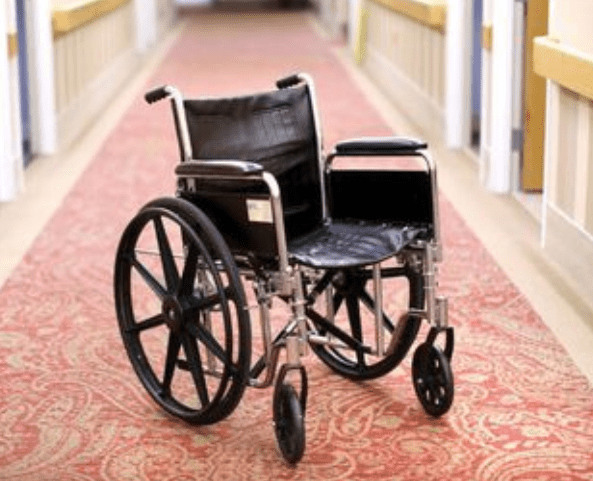
Most of us will be confined to wheelchairs and the rigidity of nursing home life. All privacy and control gone. We will awaken per schedule, bathed, and dressed per schedule, eat per schedule, watch television per schedule, and returned to sleep per schedule. The remainder of the last several years will be filled with a succession of roommates, never chosen, and jammed together like an incarcerated rat.

My father’s only crime? Being old. At one time in his life, my father had possibilities. Now he doesn’t. So, rather than thinking of something new and inventive for our elderly, we ban them from society by shuffling them off to brick corridors guarded by keypad locks and cameras.

I think the only way death becomes meaningful is to see oneself as part of something greater. Maybe there is a greater goal. If you do not find the ‘greater good,’ mortality is a horror show. As my body dies, I look at my father and wonder if I can find comfort in companionship, everyday routines, the taste of good food, the warmth of sunlight. Will I ever become less interested in the latest technology and more interested in simply being? It’s in my father’s frailty that I search my inner being and identify a purpose outside myself that makes living feel meaningful and worthwhile.

All journeys have the same ending–at a place nobody wants to go. Peaceful death during one’s sleep and swift catastrophic illnesses are exceptions. For most, death comes only after long medical struggle with an ultimately unstoppable condition—cancer, dementia, Parkinson’s, organ failure, or the accumulating debilities of age.

I still haven’t told my family of my tumor surgery, or the extensive osteoarthritis in my neck, back, knee, feet and hands. I haven’t said anything of my Parkinson’s diagnosis. I haven’t told them I’m dying.

Yet, I look at my father and outwardly admit I don’t want medicine to eat my flesh. I don’t want endless bouts of multiple chemotherapy regimens, last-ditch surgical procedures, experimental therapies, especially when the ultimate outcome is particularly clear. I would rather move on.

Moving on. That is the conversation we need. How can we gracefully move on from a world that refuses to let us go?

Oftentimes we choose badly. We barter on for the best opportunity to continue whatever morsel of time: strength, mental acuity and a life previously known just several weeks before. It is fantasy mind you. Yet we barter it all, even with the risk of a prolonged and terrible death–which is precisely what most will get.

Technically, the operation this old man received was a success. And two weeks later, the 88-year-old man and his 82-year-old wife, sat in the vascular surgeon’s office to hear the prognosis.

“Wow,” said Doctor S. “The stent looks great. The ultrasound shows the artery is wide open.”

The wife smiled. The man grunted.

“We’ll see you in two months.”

The stroke was significant, and he never recovered. In skilled nursing, the old man could barely remember why he was there; he spoke his son’s name when shown a picture of his dog; he neither say his wife’s name nor his son’s; and looked frail.

That old man is my father.

As I tried to explain to my mother, he could not be cured. Deep down, she knew there was not a cure. But admitting as much and assisting him was beyond her capability. Maybe, just maybe, that stent operation would produce a ‘miracle.’

Death, of course, is not a failure. It’s normal. Throughout the last decade, I repeatedly told my mother that modern scientific and medical marvels can significantly alter the course of human life. We can now push the final moment of many diseases farther outward. People can live longer than any time in history. In doing so, we hide the deeper reality, that such significant extensions do not come without cost. Eventually, the end makes itself known, whether it be in the lungs, brain, spine, kidneys, or heart. From there, there is no cure.

We left the doctor’s office this past Thursday knowing we’d never see dad at home again. Instinctively, my father knew he would never see his favorite lap companion (his dog) and spend Sunday’s petting while simultaneously watching Tiger Woods try for another victory. And, I wondered in the past few nights whether my mother’s ‘miracle was more for her or for my father. She always believed dad was the outlier, the guy who’d have a major injury at ninety and by ninety-one, climb the Himalayas’. Giving up meant giving up the life they built. Now, could either endure.

How did America become a world where we either have to go down with the ship or cede complete control of our life to live in a nursing home? Television is filled with young doctors performing endless miracles. We perform medical procedures (like stents), pat ourselves on the back and dish off our elderly into some unknown distant nursing home.

The reality is that most suffer alone. We depend upon nature and chance. Maybe we toss in a few overly quoted scriptures and beg for a miracle. Instead, society knowingly banishes people to Medicare/Medicaid with little options … too poor … too frail … too senile … or too broken down.

I studied my father for one last moment. “Welcome to your future bitch,” life responded.

In theory, every day is a gift. Actor Richard Evans said, “It is often in the darkest skies that we see the brightest stars.” And true to Evans’ words, I have witnessed tremendous kindness and generosity. 

A Buddhist would say our Coronavirus times should remind us of what is essential: Grandparents, fathers, mothers, sons, daughters, and family. More importantly, is there a call to review personal responsibility? While Presidents, CEO’s and our state leaders speak, cite statistics, and map out a post-COVID world, are we morally and ethically making the ‘right’ sacrifices? As we celebrate Memorial Day, would those (the “Greatest Generation”) agree that this generation is sacrificing anything?

I worry we’re not.

Tom Brokaw referred to the “Greatest Generation” as those men and women of the Great Depression, who had watched their parents lose their businesses, farms, jobs, and hopes and went directly into uniform into the military to fight tyranny. Brokaw noted that very stage of their lives, they were part of historical challenges and achievements of a magnitude the world had never before witnessed and credits them with much of the freedom and affluence we experience today.

It wasn’t all good. As many noted, during the early pre-war years against Germany, the government asked more of the public as the nation shifted to an all-out war footing. Like today, defiance of the government’s dictates was not uncommon across ideological boundaries. Just as early appeals to gather scrap metal for munitions production were ignored, today, we find it difficult to social distance and wear a face mask. And just as the Roosevelt administration’s plea for nonstop factory fostered strikes and work stoppages, I can only imagine how a person making more in unemployment than working will become motivated to sacrifice.

While American patriotism and wartime fervor played essential roles in successes, it was active leadership from the Roosevelt administration, especially its rhetoric and propaganda, which secured the buy-in. Today, we have an administration weaponizing division, promoting bogus health prevention (hydroxychloroquine) and refusing to explain what is needed and why.

We have failed to adopt clear, consistent, repeated messaging to encourage Americans in the battle required to slow coronavirus’ spread. I looked at the photos from Osage Beach, Missouri. Osage Beach is in the ‘Lake of The Ozarks.’ I am unsurprised by the crowded bars and disregard for social distancing. Yet, these people will beg medical clinicians to make every effort to save them, while simultaneously professing how innocent they are and how they did nothing wrong. 

The Atlantic summarized my thoughts well.

Some people who carried on with their nonessential weekend outings shared their rationale with reporters. One 40-year-old who went with a friend to their favorite bar on Sunday explained to the Los Angeles Times, “This could be the last bar we go to in a long time.” In Boston, a man in line at a bar with an hour-long wait reasoned to a Boston Globe reporter that, as a pharmacist, he was already going to have a high risk of exposure at work anyway, so “there’s only so much I can do” to avoid the virus. And one compassionate, though still risk-taking, D.C. diner told Washingtonian, “As long as businesses are open and the condition doesn’t worsen, I want to support those folks depending on patrons to make their living.”

Writer Joe Pinsker noted, “These are extremely weak justifications for a choice that ultimately puts one’s short-term social enjoyment ahead of the health—and maybe even lives—of countless people who are more vulnerable to the disease. Beyond lacking clear and forceful guidance from President Trump and his administration, … people have failed to apprehend the gravity of the outbreak and the importance of staying in.”

What happened to Memorial Day 2020? For first responders, clinicians, and rescue personnel across the country, sorrow will intertwine with pride of service and sacrifice. For those in Osage Beach and others with the same mentality, F••• it. It’s Miller Time.

Unfortunately, I see darker skies on the horizon.

In a world of COVID, we’ve suddenly become confined to small spaces with our spouses, with little to no reprieve. During the ensuing weeks and months, we’ve got to balance work life and personal life, 24 hours a day, seven days a week. 

In a lot of ways, many marriages will receive a glimpse of life in retirement. Spouses will look from different lenses—one may think the sky is falling, the other believes, “Eh, no big deal.” Jada Pinkett Smith related her experience. Smith, who’s been married to actor Will Smith for 23 years, realized she didn’t know him.

“I gotta be honest. I think one of the things that I’ve realized is that I don’t know Will at all. I feel like there’s a layer that you get to, life gets busy, and you create these stories in your head, and then you hold onto these stories, and that is your idea of your partner; that’s not who your partner is. Will and I are in the process of him taking the time to learn to love himself, me taking the time to learn to love myself, and us building a friendship along the way. Let me tell you, that’s been something, to be married to somebody 20-some odd years and realize I don’t know you and you don’t know me and also realizing there’s an aspect of yourself you don’t know either.”

Building friendships is something all must do.

Just before COVID closing the world, I overheard two men discussing their lives. One man was determined to force his wife of 27 years out of the marriage. He hated everything about her, from sunup to sundown. By his logic, if his wife left, he would not lose his children’s honor, and he could marry a younger wife. He wanted a younger wife. A younger wife will fix everything.

“My wife says, ‘I just want everything to be back the way it was in the beginning,’” the first man says. “God. My wife is old. Since her chemo is over, she smells old. Her skin sags and nothing she does is satisfying. She disgusts me.”

No one can ever go back to the beginning. It will never be, “… the way it was back in the beginning.” Relationships either evolve or devolve. The problem is we misperceived what our futures will be. 

COVID kind of hits that home.

Final Thought

A couple was dining and celebrating their 40th wedding anniversary. After the meal, the husband presented his wife romantically with a beautiful, ancient gold antique locket on a chain.

Amazingly when his wife opened the locket, a tiny fairy appeared.  

“Your forty years of devotion to each other has released me from this locket, and in return, I will grant you both one wish each – anything you want.”

Without hesitating, the wife asked, “Please, can I travel to the four corners of the world with my husband, as happy and in love as we’ve always been?”

The fairy waved her wand with a flourish, and magically there on the table were two first-class tickets for a round-the-world holiday.

The fairy looked to the husband, “Your turn.”

The husband thought for a moment, and said, “Forgive me, but to enjoy that holiday of a lifetime – I yearn for a younger woman – so I wish that my wife be thirty years younger than me.”

Shocked, the fairy waved her wand, and the husband became ninety-three.