Tag Archive: Buddhism


Showing Up

imageI spent much of the day yesterday recovering from the crushing rock that landed on me (i.e., my heart attack). And while hospital food will never have the appeal of that found on Iron Chef America, Iron Chefs will never have the appeal of most healthcare clinicians.

I’ve been pretty bless by an array of doctors, nurses, technicians, and volunteers who pound the pavement between hospital rooms. Most have an innate beauty to quell the suffering which lay inside even the most hardened patients. Like canyon water searching the crevices, their compassion percolates throughout exterior pores and seek even the slightest entryway unto the soul. Thus, the moats and castle walls lay ruin by the waves of love and wash us anew by replacing dearth with light.

Like most clinicians, there are momentary bouts of doubt, when one ponders if all they do benefits anyone. Surely, the daily battle of grace against doubt, of life and death, are artistically chiseled into age lines, frowns and sighs.

Sigh,” exclaimed one nurse. “Another lost.

But another saved,” responded another.

But do I make a difference,” she queried.

That’s the key, “Do I make a difference?” Common threads exist between nurse and physician, between clinician and patient. Unbeknown to them, they lead with compassion and resilience, oftentimes bridging the gap between agape love sought and found. In silent servitude, they give most another chance at life, while providing closure and transition to those nearing their time. It’s a remarkably beautiful and and eloquent dance.

Each of us makes a difference simply by showing up. If you reflect upon key events of life, they’re often more beautiful and special than first realized. Almost all people have positive qualities and hidden gems. The essential point of focus is, do we search for the dirt or search for the gold?

Former Microsoft employee Scott Berkun explained on his last day at Microsoft, he lectured and thanked a colleague, saying he’d never expressed his admiration before because he assumed it was apparent. According to Scott:

…it takes a better man to acknowledge goodness in others than it does to merely be good oneself. Anyone can criticize or accept praise, but initiating a positive exchange is a hallmark of a difference maker.

As John F. Kennedy said, “One person can make a difference, and every one should try.”

To my nurse, I thank you. You do make a difference … simply by showing up.

Give it a try – show up.

imageNRA General Counsel Bob Dowlut has been a key architect of the gun lobby’s campaign to basically get as many guns into the hands of ‘Good Guys’ as possible. He helped oversee the NRA’s effort to strike down Chicago’s handgun ban, is the longtime secretary of the organization’s Civil Rights Defense Fund which spends millions assisting gun owners in court. His journal articles have been cited by federal judges and are quoted by pro-gun activists.

So what’s the problem? Well, Dowlut himself killed a woman with a firearm.

As Mother Jones reporter Dave Gilson wrote:

“Two days prior to Dowlut’s confession, Anna Marie Yocum was murdered. She was shot three times, once through the chest and twice in the back, likely at close range as she’d either fled or fallen down the stairs. Two .45-caliber bullets pierced her heart. And after several days of interrogation, Dowlut confessed, led police to the weapon, recovered the weapon and matched the bullets from the victim.”

Prosecutors tried and convicted Dowlut. After serving serving six years of a life sentence, Indiana Supreme Court found police overzealously violated Dowlut’s constitutional rights during the confession. Hence, police denied Dowlut a lawyer despite multiple requests.

Dowlut moves forward in his life, receiving a law degree and becoming the NRA’s General Counsel.

I find it strange how the NRA spokesperson Wayne LaPierre actually has the gaul to say “put more guns in the hands of good guys,” when Dowlut in fact appears to be one of them ‘bad guys.

Life is stranger than fiction.

As Mr. Gilson’s so eloquently poses: “Was Dowlut railroaded or is he a ‘Bad guy with a gun?” Some will claim Dowlut turned his life around, became a model citizen and advocate. And all that may be true. But what of the question I ask, “How about Anna Marie Yocum? How would she feel?” Oh yeah, she’s dead.

Martin Luther King noted:

“The ultimate weakness of violence is that it is a descending spiral, begetting the very thing it seeks to destroy. Instead of diminishing evil, it multiplies it. Through violence you murder the hater, but you do not murder hate. In fact, violence merely increases hate…Returning violence for violence multiples violence, adding deeper darkness to a night already devoid of stars. Darkness cannot drive out darkness; only light can do that. Hate cannot drive out hate: Only love can do that.”

serenityThere’s always a strange weirdness felt when being followed. Sudden inexplicable moments where one senses a curious onlooker, a faint breeze where none could be found, a gentle touch when none are around. At times, I even felt Ms. K’s presence. For me, the past several weeks have been filled with the invisible, yet visible.

Maybe these moments were angels surrounding me with a sense of peace. Although unusual, such experiences might also be attributed to the disease lying stealthily within. Better yet, maybe these are the last futile moments of a broken man whose life has seemingly accounted for little. In either case, I am both touched and perplexed by such random experiences. I often wish to explore them as friends versus some episodic tryst of nature.

Last night’s sleep began like any other night. Bathe, brush and floss, open the window to adsorb the cool 62 degree night air and slip beneath the sheets. The 30 gallon aquarium hum offered a serenity of peace as water circularly percolated. Before slipping into dream, there were no unusual thoughts, no obsessive task boring through my mind. I was at ease, at peaceful.

2:36 AM drew quickly, as the severe pain tore through my left shoulder, radiating down my left arm. Mentally, I knew right away … another heart attack. I remember blurting to my phone, ‘Siri! Call Hospital.‘ To which I laid silently, resigned to succumbing.

Everything went quiet and felt as though sleeping. There was no pain. No struggle. Silence. An inexplicable sense of peace. For a brief moment I just felt as if everything was alright, like a huge weight had been lifted and I could finally be free.

I awoke finding the Fire Department Paramedic, “Welcome back.” I quickly retorted, “Sorry to have awoken you. I meant to have this heart attack at 2:36 PM.”

Processing this morning, I at no time felt death was the end, it seemed to merely signal the end of body. The spirit seemed to remain at a higher purpose. I saw no angels but but I also knew she was there. Simply put, I felt love.

Some Buddhists claim the way we pass reflects the way we lived our lives. Thus, a good death (if death could ever be considered good) places a ‘good stamp‘ on a life well lived. Personally, in light of many horrific tragedies, can one really place such connotations upon the victims of Flight MH17, Japan or Indonesia tsunami victims or children shot by stray bullets in an apartment complex in Chicago?

What I am reminded of is of the closeness of death. I will emphasize an importance in getting to know death and take time to prepare, to those whom you do love. Secondly, live in a manner you believe is responsible, good and positive for yourself and towards others. This leads to calmness, happiness and an outlook which contributes to a calm and controlled mind.

Lead a compassionate life and have no regrets. Be grateful for what we have but do not clutch and cause ourselves to suffer more than needed.

~Peace~


Nomadic Life

Nomad 2A friend inquired upon whether I am doing what God (or life if you will) destined. To be honest, yeah, kind of, sort of, maybe.

To answer lovingly, I must accept that while I’m doing what I’m exceptionally good at, there is an uneasy restlessness. True to the meaning of my real name, I constantly feel the need to wander, to see the world, to live and die in the moment. Yet I tend to feel somewhat unimportant.

As the Bassist Charlie Haden opined:

I think it’s very important to live in the present. One of the great things that improvising teaches you is the magic of the moment that you’re in, because when you improvise you’re in right now. You’re not in yesterday or tomorrow — you’re right in the moment. Being in that moment really gives you a perspective of life that you never get at any other time as far as learning about your ego. You have to see your unimportance before you can see your importance and your significance to the world.

I’ve accepted the vision others see – that standing in crowds or during a church choir harmoniously singing unto heavens, a silent, solitary man witnesses each moment of life. Like a breeze sifting through a lone willow, I agile past most, savoring the brief momentary cusp before drifting onward upon natures wings. This silent exchange offers refuge from life’s frost, triages wounds and prepares the inner soul for another journey.

Knowing how to live alone does not mean to live in solitude, separated from other people, on a mountain in a cave. A nomadic lifestyle is not complete isolation, for one does intertwine with those who walk near, serve at restaurants and stores, those whom become my seat-mate on longer flights and so on. “Living alone” means living to have sovereignty of yourself, to have freedom, not to be dragged away by the past, not to be in fear of the future, not being pulled around by the circumstances of the present. We are always master of ourselves, we can grasp the situation as it is, and we are sovereign of the situation and of ourselves.

Still, a life of wandering requires one to accept some level of self-imposed internal isolation. And for those traversing such barren and lush lands, one often discards the very relationships most others accept, thrive upon and adore.

So, it’s very natural to query, “In living such a life, is it possible to love? Have I loved?” Of course, as my letters to Ms. K. can attest. In her, I saw the true nature of life, and arrived at a great freedom, built in the essence and foundation of true love. Some openly inquire of the lessons learned of love itself. And to those seeking to understand, I simply paraphrase Vera Nazarian, “… true friendship (and to me, true love), once recognized, is in essence effortless.” If it ain’t, then it isn’t.

I have a very clear picture of what I want to do and what I feel is important as far as my contribution or my appreciation and respect for this life we’re living. As a result, I tend to believe there’s a higher chance of finding a soul-mate if I’m doing something truly loved.

Buddha once recited a gatha:

If you live without being imprisoned by the past, not being pulled away by the future, not being carried away by the forms and images of the present moment, living each moment of your life deeply, that is the true way of living alone.” Do not live alone just as an outer form, and there was a deeper way to live alone.”

Writer Rainer Maria Rilke penned, “I want to be with those who know secret things or else alone.” I focus on the present, for that’s where I’m destined to be.

Live the moments of daily life deeply and love.

ImmigrationUnless you’ve lived under a cloud for the last several months, illegal immigration appears to have become a distressing issue. Just raising the issue is almost guaranteed to extract diverse viewpoints with such passion that common everyday people burst into open battle.

Going back to New York’s Statue of Liberty where thousands of immigrants passed nearly a century ago and query, “What’s the most famous quote on the Statue of Liberty?” One may receive the following:

Give me your tired, your poor, your huddled masses yearning to breathe free.

Contrast New York to Texas. In a recent speech of floor of the US House of Representative’s, Texas’ Republican Representative Louie Gohmert compared the surge of migrant children to soldiers invading France during World War II. “Our continued existence is at risk with what’s going on at the southern border,” he explained. Gohmert also added that the Department of Homeland Security was complicit because it had “… actually assisted the criminal conspiracy in achieving its illegal goals” by not enforcing the law. Gohmert also asked Texas Governor Rick Perry to “use whatever means,” including troops, ships of war, or taxes to “stop the invasion.”

Immigration is a significantly difficult topic. However, all I’ve seen is an overt form of racism and the dehumanization of children. This form of racism often centers upon protecting national borders, i.e., “the American way of life.” Additionally, news sound bites profess to economic costs, added pressures to schools, disease, and law enforcement. These may be legitimate issues, but there is no explicitly Christian orientation to the debate.

If you want to focus Biblically, then one needs to go no further than Leviticus 19:33-34:

When a stranger sojourns with you in your land, you shall not do him wrong. You shall treat the stranger who sojourns with you as the native among you, and you shall love him as yourself, for you were strangers in the land of Egypt: I am the Lord your God.

Instead of that, our current form of Southern Conservatism slaps a heavy dose of naive anti-intellectualism with bullshit. As Reverend Cornel West noted, “the fundamentalist Christians want to be fundamental about everything, except ‘love thy neighbor.’

In truth, all of us are immigrants and sojourners in the world.

Early Buddhism is mostly silent on immigration. And while it’s hard to argue against enforcing the law, we should also be looking at what compels many people to risk their lives and freedom crossing into the US illegally. Could it be that our own economic policies perpetuate injustice and poverty in their countries? Could our political and military actions be undercutting democratic movements and propping up unpopular and oppressive dictators? Instead, we should work hard to reverse the trend of poverty and injustice. If their lives are better in their home country, then I’m sure they’ll be more patient with the legalities of proper immigration.

The Statue of Liberty quote originated from Emma Lazarus’ sonnet, ‘New Colossus.’ New Colossus was written for the pedestal fundraiser upon which the Statue of Liberty rests. In it’s entirety, New Colossus is as follows:

Not like the brazen giant of Greek fame,
With conquering limbs astride from land to land;
Here at our sea-washed, sunset gates shall stand
A mighty woman with a torch, whose flame
Is the imprisoned lightning, and her name
Mother of Exiles. From her beacon-hand
Glows world-wide welcome; her mild eyes command
The air-bridged harbor that twin cities frame.
“Keep, ancient lands, your storied pomp!” cries she
With silent lips. “Give me your tired, your poor,
Your huddled masses yearning to breathe free,
The wretched refuse of your teeming shore.
Send these, the homeless, tempest-tossed to me,
I lift my lamp beside the golden door!”

Ms. Lazarus’ poem did not receive much recognition and was forgotten soon after the fundraiser. However, maybe we should be shunning the lamp of ignorance and give the huddled masses an opportunity to breath free.

Screen Shot 2014-07-21 at 7.49.45 PMMy favorite line in The Secret Life of Walter Mitty is beautiful things don’t ask for attention. When Mitty finally finds Sean O’Connell, whom he’d been looking for throughout the film, O’Connell had been in front of his lens for hours, watching a white tiger.

O’Connell declares beautiful things don’t ask for attention.

“When are you going to take it?” Mitty queried.

“Sometimes I don’t,” O’Connell responded. “If I like a moment, for me, personally, I don’t like to have the distraction of the camera. I just want to stay in it.”

“Stay in it?”

“Yeah,” O’Connell clarified. “Right there. Right here.”

Real beauty is only visible for true beauty seekers to see. The Apostle Peter referenced much the same in 1 Peter 3:4-4:

“Your beauty should not come from outward adornment, such as elaborate hairstyles and the wearing of gold jewelry or fine clothes. Rather, it should be that of your inner self, the unfading beauty of a gentle and quiet spirit, which is of great worth in God’s sight.”

O’Connell, however, was referencing the infamously lost photograph, number twenty-five, to which the audience sees only at film end. Only then do you realize O’Connell was referencing Mitty.

Mitty, “What was the picture?”

O’Connell, “Let’s just call it a ghost cat, Walter Mitty.”

Like a Zen master teaching, we’re reminded to live in the moment – to stop and be open to the beauty surrounding us. We need to just “enjoy” the moment.

Prior to his journey, Mitty’s lifestyle was drab. He went to work, hid in the background, and took care of his unemployed mother and sister. This version of Walter is kind of depressing for he reminds us of who we are right now—the person who’s just a number in society, who’s working hard to support other people. What’s sad is Walter resigned himself to the meaning others ascribed. And sadly, many of us accept these labels and become them. The Secret Life of Walter Mitty reminds us our time and work in life derives the most meaning only when we are working in and for the lives of others.

When O’Connell decided not to take a picture of a snow leopard, he told Walter he wanted to experience the moment rather than seeing it through a filtered lens. The ‘lens’ in this sequence is metaphoric of Walter’s daydreaming, even of our own.

Number 25 is my best ever, “O’Connell wrote in the opening film sequence. “the quintessence of life, I think. I trust you’ll get it where it needs to go, you always do.”

In truth, the most beautiful things don’t come from self-indulgent movie stars. These come from ordinary everyday people … like you and I. Some things don’t require a photo or an iPhone ‘selfie’ – you just need to live them.

Maxwell Maltz phrased it well:

Within you right now is the power to do things you never dreamed possible. This power becomes available to you just as soon as you can change your beliefs.”

Just be. Live.

Empty Your Cup

overflowing-cupA friend received her PhD several years ago. During the subsequent search committee interviews for academic teaching and lay ministry, committee members queried her accomplishments. Without hesitation, she provided an exhaustive doctoral background:

I came from another country and English is my third language. I have a near ‘genius’ IQ; went to the number one college in my own country; received a Masters from the top sixth academic university in the United States’ and received my PhD, summa cum laude while simultaneously receiving a ‘Fulbright Scholar.’ I have fourteen years of counseling experience; read over a thousand books in the last three years; wrote for leading academic journals; performed research and am a world-wide acclaimed speaker.”

Needless to say, she received a tenured academic position.

Upon meeting someone new, she reiterated parts of or all of the above. When feeling neglected or looking for affirmation, friends and family were reminded of her accomplishments.

Two weeks ago a local hospital required an interim Chaplin. After contacting the hospital CEO, the interim position was awarded to her care.

Coincidentally, an academic search committee member from several years prior required surgery. Glancing through the hospital admission log two days ago, she found a record indicating both his faith and room assignment, room 304. Upon visiting the third floor, the nurses barred entry to the patient’s room. The note stapled to the outside medical record jacket was informative:

Patient does not want to see current hospital Chaplin unless he’s in a coma.”

We are so enamored of our own ideas and opinions that our conditioning traps us. If we empty ourselves out, let go, and cease to hold on to our views, a more pure truth will come. Many of us cherish our opinions, for we’ve been taught such value by our elders. All of us need a way of approaching each encounter freshly. Be open to the moment, toss aside the past. Cultivate an inclusive mind of love, one that is able to meet every moment and be filled by the moment versus filling the moment with our own home movie … to which so few wish to see.

Experiencing the peacefulness of true love requires an empty cup.

Knowing God

imageI read an article by a friend who claimed to know all about God. Simply put, by reading and studying the Bible, he was able to know God. I counter by stating Islamics, Jews, Muslims and most every other religion opine in a similar way. If one reads and study that one book for one month, one year or one decade, can you really completely learn about God?

Thomas Aquinas’ may have phrased the concept correctly when he wrote, “This is what is ultimate in the human knowledge of God – to know that we do not know God.”

Often times, while watching the news of one tragic event or another, someone often sputters, “Is God a loving Father or a great vivisectionist?” Honestly, even several spiritual experiences, God remains quite the mystery. I cannot always understand His logic, His love, His hatred or His grace. I have no clue if Jesus hates brussels sprouts or liver and onions as much as I. Nor can imagine what His purpose is for the Mojave desert, the Chicago Cubs winless streak or the ‘Keeping Up With The Kardashians‘ television show.’

I do know many view God from a myopic personal viewpoint. For instance, when the father of the friend mentioned above became sickened from cancer, he loudly queried, “Why did God allow this to happen?” Yet when 15,887 people died in the Tōhoku earthquake and another 6,000 from the Philippine typhoon, nary a question was raised.

Thinking out loud, is it better sometimes for calamity to strike? Could such calamities awaken the deep root our own prejudices and snap them from the limb of our own tree?

I think the real tragedy is that all of us believe we know more of God than we actually do. Thus, we never etch a serious time in discovering the love He claims to have afforded. So I ask each of you today to drop your concepts, drop your opinions, drop your prejudices, drop your judgements and explore God’s love.

What does He look like now?

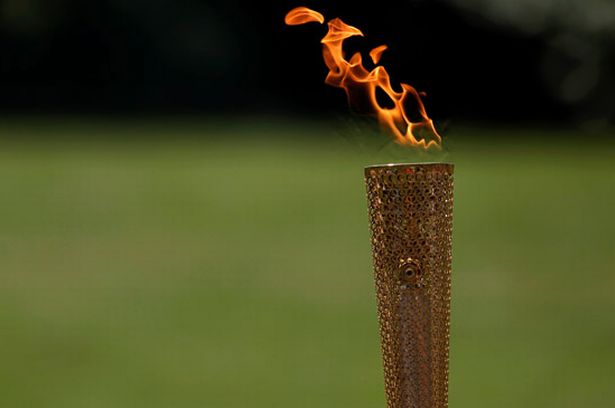
Olympic_TorchA friend often claimed her given name meant “light.” Accordingly, she was quite the scholar; with a near genius IQ who performed elongated math equations in her head. During her travels, she claimed to have found no one of equal. Thus, she fictitiously carried a lighted torch while claiming to “Light a world largely dark.”

One day, a wise man sitting in a darkened coffeehouse heard her words. “My friend, if your eyes are blind to the sight of the omnipresent light of the day, do not call the world dark. Your torch adds nothing to the glory of the sun and your intention to illumine the minds of others is as futile as it is arrogant.”

As Anthony de Mello would say,

“We all need to identify less and less with the “me.” By doing so, we’ll all be more at ease with everybody and with everything because we’ll no longer be afraid of being hurt or unlike. We need to reduce the desire to impress everyone. Can you imagine the relief when you don’t have to impress anybody anymore? Oh, what a relief.

So why do I refer to de Mello and being one of ‘true light?

While flying to upstate Washington over the weekend, a woman saw me reading de Mello’s work, ‘Taking Flight.’ Being a devote Christian, she claimed to know the true “Light” and opined that de Mello’s books did little to enhance one’s development in authentic Christian spirituality while simultaneously exposing the soul to serious spiritual danger.

Additionally, I should consider, “… that dabbling in Buddhism, Taoism, and other ideologies isn’t just a simple pastime. These practices could expose one to occult influences that could have lasting and damaging effects upon the mind, body and soul. So unless one is attempting to communicate with the One, Holy and True God – and in ways deemed acceptable – I need to understand I’m placing myself at enormous personal risk.

Paraphrasing Dale Carnegie, I subtly responded, “The ideas I stand for are not mine. I borrowed them from Socrates. I swiped them from Chesterfield. I stole them from Jesus. And I put them in my life. If you don’t like their rules, whose would you use?”

Oh,” she beamed with a broad smile. “They are worthy leaders.”

Leaning back and looking over Washington’s coastline, I muttered in thought, “Socrates would talk with people he encountered on the street, using the opportunity to question them about their views on justice, piety, courage, and other virtues by which human beings lived. His pointed questions–and the inability of his listeners to answer them satisfactorily–showed them that their knowledge was incomplete or tainted with faulty ideas. For this, he received a death sentence.

Most will not believe in the real God because they’re unable to broaden their minds past that of their own world.

Never Have an Unnatural Death

A-climber-is-not-a-crazy-man-he-is-not-trying-to-get-himself-killed-he-knows-what-life-is-worth-he-is-in-love-with-living1A friend of mine asked me how I’m able to face the prospect that soon I will die. My response was delivered in the following parable.

One day a neighbor saw the Angel of Death.

Surprised and fearing for his life, he went unto his friend. “Please kind sir, may I borrow your car and drive away. I will drive 6 hours toward Chicago and hide.”

Being a kind friend, he plopped the vehicle’s keys into his neighbor’s hand and watched as the vehicle drove off unto the horizon.

Curious, the wise friend questioned the Angel of Death.

Why did you surprise and scare my neighbor?”

Sorry,” replied the Angel. “I was surprised as well.”

How so?

Well, I’m totally confused. My appointment calendar has a meeting scheduled with your neighbor tonight near Chicago.”

Most of us don’t usually want to think or talk about death. Be it conscious or unconscious, there is a fear, a tendency to avoid it. Thus, similar to the reworded parable I borrowed from eons ago, death will come regardless of whether or not we’ve made time to practice spirituality. And most certainly, we can’t run from it either.

Contemplation of death is not for making us depressed or morbid, it is rather for the purpose of helping to free us from fear. The values that we have in life will change quite drastically once we stop living as if we are going to live forever, and we will start living in a quite different way.

Dr. Larry Wilson once said those who fear the death the most are those who haven’t lived. It’s important to live our lives more fully, with more joy, with more gratitude and appreciation. If we live our lives as though we were going to live forever, we wouldn’t appreciate the life given. Instead, we take life for granted and live in a very foolish and heedless way. We all live in foolish ways, simply because we don’t consciously contemplate the fact of death.

Anderl Heckmair spent his life as a mountaineer and led the first successful ascent of the North Face of the Eiger in 1938. Sometime during the 1930’s a fortuneteller told him he would die an unnatural death. “Oh no!” he exclaimed. “That means I’ll die in bed.”

I hope to never have an unnatural death.

———- Post Script ———-

Anderl Heckmair lived until the age of 98.