Category: Social Justice


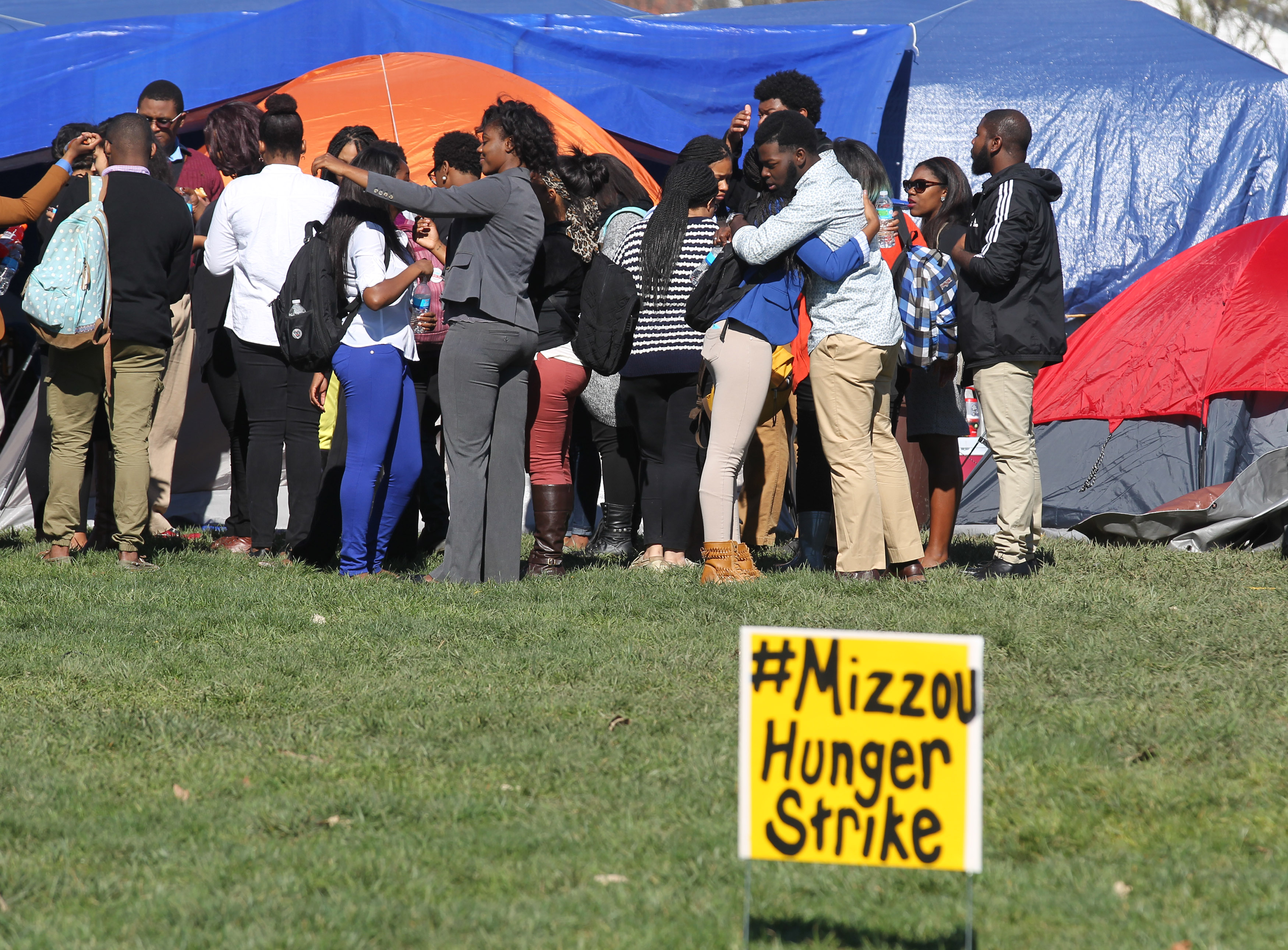
Missouri graduate student on hunger strikeMissouri University President Timothy M. Wolfe, stepped down early Monday morning. Later in the day, the Columbia campus Chancellor R. Bowen Loftin also bit the dust. The issue was Wolfe’s lack of response to a recent spate of racist incidents on Mizzou’s campus, where graduate student Jonathan Butler’s protest received the support of Mizzou’s football team. Butler’s response to recent wave of bigotry came in the form of a hunger strike.

“I will not consume any food or nutritional sustenance at the expense of my health until either Tim Wolfe is removed from office or my internal organs fail and my life is lost.”

It’s good to die for something worthy.

In truth, Wolfe was probably forced out by a set of unified stakeholders, from internal department heads to state legislators. The backstage strategic puppeteering in such high-press cases is amazing. Today, the unique role is litigating in the court of public opinion where evidence and personal bias gets shoved down a listener’s throat is powerful.

One key group was Concerned Student 1950, formed on Mizzou campus in response to racially-motivated incidents. (1950 referred to the year black students were first admitted to the University of Missouri.) Concerned Student 1950 demanded the removal of Tim Wolfe, whom they felt had not handled these incidents well, if at all. Butler noted:

“Students are not able to achieve their full academic potential because of the inequalities and obstacles they face,” he said. “In each of these scenarios, Mr. Wolfe had ample opportunity to create policies and reform that could shift the culture of Mizzou in a positive direction but in each scenario he failed to do so.”

Personal bias aside, “Bullshit!.”

Former Mizzou football player A. J. Ofodile raised a valid point. To Mr. Ofodile, the 1950’s-style oppression wasn’t apparent.

“Through this whole process I haven’t heard one example of any oppressive action or policy that is systemic in nature. I’ve seen tons of examples of individual bigotry and claims that those incidents weren’t handled appropriately but at this point I have to seriously doubt that people fully understand what systemic oppression really is.”

So this is the same Mizzou that’s so racist it elected a black man student body president and homecoming king? Or, are we to believe Mizzou racists systematically elected the black student body president only to hurl racial insults? Is this the same Mizzou that embraced gay defensive lineman Michael Sam in 2014? And nearly 18 months beyond Sam, Mizzou is fraught with racism?

Seriously?

Still, after hearing of Wolfe’s resignation, students danced where activists had set up a tent city. The football team announced that it was ending its strike and hundreds of students chanted in the sun, “I … am … a … revolutionary!” Social media users around the world joined in, tweeting more than 100,000 times the day’s protest.

While I believe incidents of racism must be addressed, what will be interesting is watching how Mizzou students and residents struggle with their response. Even if all the reports of racism prove accurate, Mizzou’s president shouldn’t have been adjudicated via a lynch mob mentality that served no meaningful purpose other than to inflame.

I propose that losing $1,000,000 of football revenue is what really forced Wolfe to resign, more cash than protest. Yes, football gold and the massive amounts of money pouring into the ol’ football coffer.

So I repeat what I wrote after the Ferguson Riots. After the cameras stop rolling, they’ll (Mizzou) be left nearly in nearly the same place they started. After all the sound bites and television interviews, someone will query, “What did we accomplish?“ Probably not a hell of a lot.

Real change requires effort and love. But no worry for Butler. Technically, Butler won. He received his pound of flesh. However, what Butler and others will learn is that whether right or wrong, every university has an adjudication process. And sometimes that very process is goddam slow. You can’t cure cancer via instant soup.

Mizzou will play the remaining three games. That’s approximately $3,000,000 bucks into the coffers. One University President was sacrificed unto the football gods. And football players run the university.

Good Lord! All hail the “Pigskin God.”

Screen Shot 2015-11-05 at 2.20.07 PMVisiting San Diego this week, I had the chance to visit Juárez, Mexico.

A PRI The World program noted that once known as “the murder capital of the world,” Juárez is still recovering from cartel violence and some on both sides of the border say they feel safer. Despite current politics surrounding immigration, people constantly flow back and forth on a daily basis. Some who ebb in and out of the yin-yang flow are students.

These students travel, each day, from Mexico to the US, all of to break the cycle of poverty.

Families living in extreme poverty see quality education as an impossible cost. Even public school carries costs, including books, uniforms, and transportation. Because parents have not experienced the increases in earnings, quality of life, and personal dignity that come from education, they don’t know what they are missing by pulling a child out of school to work instead. This is why it’s a cycle: children who grow up without education are less likely to send their own children to school.

By providing a quality education, a vicious cycle gets replaced. Instead of poverty sowing the seeds for still more poverty, education creates an environment that leads to opportunities and education for successive generations as well. Instead of leaving school to work, children have the chance to engage their intellectual curiosity, and live in a more stable society.

Children in poverty are less likely than middle-class children to develop basic educational skills before kindergarten. Too often, poor children have fewer early learning experiences. For example, poor and low-income children tend to live in homes with fewer books and less language stimulation.

If society wants to adopt a quality lifestyle for all children, then breaking the cycle of poverty requires investing in our children and ensuring they have nurturing and enriching experiences, including high-quality early care and educational opportunities.

Yet few politicians offer solid solutions.

Governors in Arizona, Kansas, Louisiana and Wisconsin and Connecticut’s Democratic governor have proposed higher education cuts for the 2016 fiscal year. Higher education spending traditionally is a juicy target for budget cutters because schools can make up the lost revenue by raising tuition.

A day before jumping into the race for the 2016 Republican presidential nomination, Governor Scott Walker signed a state budget that, among other things:

  • Slashed $250 million from the University of Wisconsin;
  • Expanded the state’s voucher program that uses public funds to pay for tuition at private schools, including religious schools — even though there is no evidence the program has helped improve student achievement; and
  • A majority of public school districts in Wisconsin will receive less funding this year, and no school district’s state funding will keep up to inflation.

If the Buddhist principle that all things are connected is correct, then our own fate and the destiny of the world may be intimately bound up with the educational fate of the poor. No country has ever achieved continuous and rapid economic growth without first having at least 40 per cent of its adults able to read and write.

Statistics show why education is perhaps the most effective strategy to tackle poverty and is integrally linked to human, community and national development. When people have basic life and literacy skills, economies grow more quickly and poverty rates decline.

I remember a scene from Saving Private Ryan, where Captain John Miller said, “This Ryan better be worth it. He better go home and cure some disease, or invent a longer-lasting light bulb, or something.” From time I wonder if an errant drone strike destroyed the world’s chances to cure cancer? It is just me, or does anyone ever think some terrorist annihilated humanity’s best chance to defeat Alzheimer’s?

Decreasing poverty through education is very Buddhist and very Christian.

Screen Shot 2015-11-04 at 9.48.32 AMIn my post about Mississippi: Faith Without Works, I noted, “If we are pro-life, then we must be pro-quality of life. If we do one without the other, our works is inconsistent with our faith.” I wrote that in July 2012. And some three years later, that post lived a quiet, subdued life, archived to distant memory, maybe wasted space or rolling of the eyes.

Then came Governor Christie’s recent comments about addiction. I can’t say the following text is 100% accurate. It’s close. I tried transcribing Christie’s comments correctly:

“My mother was a smoker. She smoked her whole life. She was addicted to nicotine. She started when she was sixteen (16), which was 1948. 1964 came, the Surgeon General’s report came out and she was in her mid thirties. She knew smoking was bad for her. And I’ll tell you, watching her as a kid growing up; she tried everything she could to quit. She had the gum, the patches, and hypnosis. She tried everything. She couldn’t quit.

Now, when she turned 71, a little after that, she was diagnosed with lung cancer. No one came to me and said, “Don’t treat her, for she got what she deserved.” We know the lung cancer was caused by the smoking. We know it was. But no one came to me and said, “Your mother was dumb. She started smoking when she was sixteen. Then after we told her it was bad for her, she kept doing it. So we’re not going to give her chemotherapy. We’re not going to give her radiation treatment. We’re not going to give her any of that stuff. You know what, she’s getting what she deserves.”

No one said that. No one said that about anyone having cancer.

Yet somehow, if it’s heroine or cocaine or alcohol, we say, “We decided they are getting what they deserved.”

I am pro-life. And I think if you’re pro-life, that means you have to be pro-life for the whole life, not just the nine months in the womb. Alright? It’s easy … It’s easy to be pro-life for the nine months in the womb, for they haven’t done anything to disappoint us yet. They’re perfect in there. But when they get out, that’s when it gets tough.

The sixteen year old teenage girl, on the floor of the county lockup, addicted to heroine … I am pro-life for her too. She has just as much a precious gift from God as the one in the womb. And we need to start thinking that way as a party and as a people and the President needs to say those things.”

Like MSNBC host Joe Scarborough, “I’m still kind of blown away by Christie’s comments.”

Whether you agree or disagree with Christie’s overall political views, his comments of being pro-life for life were genuinely real. They were the perfect “in the moment, from the heart” stuff. I wish all politicians spoke accordingly.

Christie’s comments were very Buddhist, very Christian. How beautiful! Imagine living in such a world … Pro-Life for Life?

——————————————————–

See Christie’s complete video by clicking his picture.

imageOn some level, maybe I’ve grown accustomed to ignorance. Not that I’m completely ignorant, but more so that I’ve got an ability to ignore that which surrounds. That whole statement sounds so New York. And maybe in that light, I’ve become more New Yorker each day.

For instance, I week ago I once threw change to an old man struggling on two canes. The weathered seventy something year-old glisten Fuji Apple red in the morning light. Eaten by blistered peeled skin, his hands shook unceasingly like a Home Depot paint mixer. There was no computer genius here, no lost mathematician or concert pianist. He was a societal cast away.

Yet dropping a few coins into his coffer became his morning ritual. That seemingly downtrodden man followed me, found where I worked and met me there each morning for several days. He became a pseudo toll agent and stood defiantly in my path until someone produced a few coins.On several occasions, I tossed a few outdated tokens obtained at a western Indian casino. After deducing who the culprit was, this gentle soul became belligerent. One morning, he was hauled away by NYPD authorities and I never saw him again.

But this reminded me that sometimes acts of kindness become entitlements. I am not not referring to entitlement programs offered by the government for the poor. Rather, it’s when an act of compassion is interpreted as comeuppance. And that’s what addicts do.

So many times in my life, I looked for hourly, daily, weekly and monthly comeuppance. It was a prerequisite to the day. At the end of the day, I became just like a New York castaway. And tired of my shit, people no longer moved to help. They sat. They watched. They commented upon my fall from grace and laughed.

Their lack of faith in my humanity did not dissipate overnight. Rather, I chiseled away my own humanity piece by piece, moment after moment, excuse after excuse. Like ‘Red’ in the ShawShank Redemption, I’ve lost my humanity, not because I’m an addict of this or that, because you think I deserve it.

The list of those celebrating my demise were many, Katherine K., Karen N., Joanne F., Mari T., Matt M., Tim B., H.H.H., and many many more. Yet no matter what anyone thought of my life’s experiences or worth, like all people, there was so much more underneath to learn. But no one did. Instead, personal redemptive efforts were suffocated, smashed and crushed like used cigarette butts.

There were many sleeplessness nights, where the desolate prodding of loneliness and loss accumulated like anvils. If I had life-affirming qualities, there were extended periods they where unacknowledged. But in that depth of darkness, I learned to tolerate life’s burs. Eventually, I became tough, calloused and could bear the verbal abuse of a thousand men. I became like and unlike those who walked New York’s concrete pavements. Like them, I wandered in-between corrugated steel girders almost without notice. Unlike them, I was full of compassion, love and beauty whose flowers simply waited for a few drops natures nectar.

It’s a weird place – a divergence between heaven and hell. But at the end of the day, we manufacture our own hell quite well. Find a way to live in heaven.

New York Grime

imageAs I think about it, trial and error is vastly overrated. I keep hoping the next town, the next person met will open some unknown mantra and shed light unto Shangri-La. Yet addicts repeat steps others accomplished. Or mostly, what others haven’t accomplished. We continually yearn for the ‘something for nothing.’ Our often depressing day-in-day-out life relishes an idyllic world, where hope cures ills, where the guy gets the girl, bravery trounces cowardice and justice wins.

Addicts and common folk alike, simply cannot accept that we must do something for ourselves. You got here, wherever that ‘here’ is by yourself – and accordingly, we’ll have to find a way out of it – by ourselves.

New York City reminds me of all this and more.

My first impression of New York is vastly different from television. For the true witnesser, one quickly understands that dirt covers everything. Architecturally speaking, in the midst of all the grime, nothing seems eloquent. People become after thoughts. Streets are witnesses to personal unseen demons. Street grates and vents are clogged by strewn trash. The discard of humanity is archeologically petrified by wind, rain, snow and salt. Why toss stuff into a trash can when the street’s receptacle is logical, quick and readily available?

Whether we care to admit it or not, all us are like New York streets. Like personal shame, hidden fear and restlessness, crushed styrofoam, discarded remnants from Wendy’s, McDonald’s, and Burger King line New York roadways. Discarded gum liners, cigarette boxes, severed construction cones, old mattresses, foam, fragmented shipping boxes dot become pseudo roadway markers.

Every six blocks Apple iPhone 6 picture is silhouetted on some large building. One in particular caught my eye. It was a picture of a lone Saguaro cactus against the backdrop of a sun burnt Tucson, Arizona sky. It’s caption read, ‘Taken by an iPhone 6.’

Saguaros only grow near Tucson, Arizona. I’ve been there. Most New Yorkers haven’t. They’ll buy into Apple’s dream, that the iPhone 6 will produce some semblance of freedom and openness. It won’t. Probably never will. Few will ever embrace the open skies of New Mexico, Colorado or see the sun flowers of North Dakota.

Statistically speaking, New Yorkers live, breathe and die in New York. Few venture beyond the stagnant miles of steel and glass. Dressed in business attire and white sun dresses, the hordes simply bustle past their surroundings, willingly accept their surroundings and their fate.

The chronically drunk and addicted are pasted against shop walls. It’s not unusual to stroll past high priced outlet stores without seeing a forgotten soul splattered against the window pane. In their eye, there is no other life, there’s no hope. They’re soulless. Days filled by walking endless concrete carpets and alleyways, sleeping here, resting there, hoping for tossed parcels of used burgers and reclaimed sub sandwiches.

It’s difficult to sort fact from fiction. These are the same folks whom conservative pendents extoll as lazy, dirty and dangerous. Yeah, they are dirty. Sure, they can be dangerous. But society’s disdain and hatred put them there. With iPhone earbud drilled embedded into ear-canals, New Yorkers, walk past these wanderers with extraordinary contempt, nary a footnote in the biography of life. We’ve consumed ourselves in ignorance.

I hate my cowardice in dealing with people.

imageThe Daily Show skewered Casebolt’s use of force at Texas pool party. Add to that Officer’s Casebolt resignation as well as dual McKinney protests: one seeking a pound of flesh with another offering support. Civil rights leaders in McKinney said they want an investigation by the US justice department. Some McKinney parents burnt an American Flag, with a child hidden behind a Halloween mask (great lesson there).

Just about everyone wants a piece of Casebolt’s arse. All-in-all, McKinney police Cpl. Eric Casebolt had a lousy week. More than likely, he’ll have a lot more.

There are groups who are focused on the specific incident at the pool party, there are groups who want to address broader issues of inequality. Some wanted Police Cpl. Eric Casebolt fired, others want him indicted. This isn’t an easy issue to tackle, and the protesters all brought a unique view and set of goals.

While McKinney, Texas may be listed as the number one place to live, equality issues exist everywhere. Given the fact no one was shot and that no mother or father had to be told a child died, I’m amazed at the lack of grace and dialogue.

Casebolt’s actions should be critiqued, but extracting a pound of flesh won’t transform anyone’s world into a center of peace and tranquility. This is a social justice issue. It’s not just about how a police officer handled a crowd, but it’s about everything we do as adults, how we view others and what we tach our children.

If media reports are accurate, here’s a recap of events:

  • The pool party was organized by 20-year-old Tatyana Rhodes, and her mother LaShana Burks. The event was unapproved and unauthorized, turned into a mob and cost the community thousands.
  • Tatyana Rhodes claims she’s a teenager. In reality, she’s a 20 year-old adult.
  • Ms. Rhodes hired a DJ and promoted the event to include a pool party.
  • There are numerous social media links reflecting that Ms. Rhodes organizes ‘parties’ and charges for attendance, as a profit generating business.
  • According to Rhodes and Burkes they were unable to control the growing crowd;
  • 100+ teens (and many young adults) turned into a mob of partygoers and began jumping the fence to the gated pool.
  • Police arrived after receiving calls regarding teens “actively fighting.” Reports that some teens and adults began fighting after an adult(s) made racist comments, reportedly telling the organizer to “return to Section 8 housing.”
  • Police Officer gets filmed by cell phone.

In summary, parents and or adults created this shit. Residents then called police to clean up their shit. But residents claimed police mishandled their shit…that their shit has to be treated better…have the courtesy to handle their shit with care. Residents then had the gall to film and skewer a police officer for dealing with their shit, in essence saying, “Don’t look at me, but let me tell you about that officer. Holy Shit”

As a Buddhist, I agree the officer should have been disciplined. But grace was the prudent course of action.

You can’t talk your way out of problems that you behaved yourself into (S. Covey).

In the end, Social Justice cannot be the excuse for personal failure.

That’s what Jon Stewart missed.

YenSidhouseofmouseLike a bad dream, Yen Sid, the powerful sorcerer, called in approximately 250 Disney IT workers and said, “Your job has been eliminated. And oh! We need you to train your replacement – from India.”

The New Times reported this week that Walt Disney World fired 250 employees, hired Indian workers on a temporary visa and then made the outgoing Americans train their replacements.

The Times story reported Disney used a temporary visa known as the H-1B to hire new workers from an Indian based outsourcing firm. The H-1B program was designed to allow American companies to import highly skilled foreigners for jobs they cannot find Americans to perform, but as always, the program is rife with loopholes and abuses.

Companies claim to use H-1B visas so they can attract the “best and brightest people in the world.” However, if you squint really hard, you’ll be able to read “…for less money than they have to pay U.S. workers.“

An excellent article by Martin Kaste for NPR’s All Tech Considered, talks about what many believe is possibly really behind all the kumbayah all-hands-across-the-water, increase-the-cap movements:

“For the past decade, he’s [Ron Hira, a professor of public policy at the Rochester Institute of Technology] been studying how consulting firms use temporary work visas to help American companies cut costs. He says they use the visas to supply cheaper workers here, but also to smooth the transfer of American jobs to information-technology centers overseas.”

Kaste further noted that H-1B consultancies are especially big in banking, insurance and pretty much any industry that runs on big computer systems maintained by aging, increasingly expensive American tech workers.

Think about this the next time you visit Disney. All hail Yen Sid!

AP_Jade_Helm_15_ml_150508_16x9_992I scrutinized Dallas Fort-Worth Airport while our plane landed in Dallas. During a brief two-hour layover, I wondered how many special forces were ready at the helm, to take over the airport and Texas as a whole. But alas … I survived.

For those out of the loop, Jade Helm 15 is a scheduled special forces training exercise across seven Southwestern states. Sparked by the stupid and associated conspiracy theories, public officials have heard inquiries from whether this may in fact be just an exercise to whether all seven states would experience martial law. Others claim Jade Helm might be part of a plot to give Texas back to Mexico, a prelude to an economic collapse, Wal-Mart store closings are really holding grounds for troops or an entry point to a series of secret underground tunnels.

One resident brought a sign to last month’s Bastrop County Commissioner’s Court hearing that read, “No Gestapo in Bastropo.” This led Todd Smith, a Republican lawyer and former state legislator, to accuse the governor of “pandering to idiots” and legitimizing paranoid right-wing machinations. Still, Governor Greg Abbott asked the Texas State Guard to monitor the operation; effectively authorizing the government to monitor the government.

Op-Ed writer James C. Moore hit the stupidity of Jade Helm’s reaction in his CNN Opinion “We Texans are brave enough to resist Pentagon:”

“While Gen. Travis laid in a supply of extra “beeves” in advance of the Mexican assault from Gen. Santa Anna at the Alamo, we are fearful of running low on Slim Jims and Moon Pies as the Wal-Mart’s are turned into detention centers for citizens robbed of their constitutional rights. As POWs (Prisoners of Wal-Mart), we expect to be put to work in the sporting goods department against our will while earning below minimum wage.”

As a Buddhist, I understand many of the fears we all have. We have fears of terrorism, fears of death, fears of being separated from people we love, fears of losing control, fears of commitment, fears of failure, fears of rejection, fears of unemployment, etc. Many of our present fears are rooted in what Buddha identified as “delusions” – distorted ways of looking at the world and ourselves.

If we learn to control our mind, and reduce and eventually eliminate these delusions, the source of all our fear, healthy and unhealthy, is eradicated. We cannot control whether things will go our way or not, but we can learn to control our own minds, our responses, and our own conduct, and in this way gradually find a genuine liberation from all fear.

As Shantideva says in Guide to the Bodhisattva’s Way of Life:

“Buddha, the Able One, says,

‘Thus, all fears

And all infinite sufferings

Arise from the mind’.”

Or, we could do as Mr. Moore suggested:

“… be not afraid, America. We are Texans. We will resist logic and intelligence to the very end. And we will keep up our traditions. From the Alamo to the Battle of Goliad, the Confederacy, LBJ’s Vietnam, George W. Bush’s Iraq War, and even Jerry Jones’ Dallas Cowboys, we have a long legacy of losing. And the odds are also against us in the coming Battle of Jade Helm, but we expect to prevail against the invaders, and we will not give up our rights.

Or our air conditioning, cold beer, and Slim Jims.”

imageCNN reported the family of Michael Brown filed a civil lawsuit against the city of Ferguson under Missouri’s “wrongful death statute.” The family suit seeks punitive and compensatory damages in excess of $75,000, in addition to attorney fees. My guess? The family will get millions.

The Brown family lawsuit raised an interesting question that I’ve pondered for several hours: “Once there’s a settlement, can the Brown family be sued by a destroyed Ferguson business owner?“

Recollecting, as Louis Head (Michael Brown’s stepfather) consoled Brown’s distraught mother after the grand jury announcement, he turned to the crowd of demonstrators and said, ‘Burn this motherfucker down’ and ‘Burn this bitch down.’ While Mr. Head apologized the following day, riots left parts of Ferguson a burning wreck.

In a subsequent police investigation, Mr. Head issued a statement saying that while sorry for screaming ‘Burn this bitch down!‘, to arrest and charge him ‘goes way too far and is as wrong as the decision (of the grand jury) itself.‘ Granted, that stance may be good against criminal prosecution, but how about civil court, where the burden of proof is only a preponderance of evidence?

Should mobs get a free pass to riot and steal in response to unwelcome political outcome? Remember, approximately 25 structures in Ferguson were burned, damaged, or destroyed during riots following the grand jury verdict. Has any of the protesters paid for damage sustained? Sam Chow, an immigrant opened a Ferguson restaurant in 2009. His restaurant practically whipped. Where’s the outrage for the death of Zemir Begic? Begic, a young immigrant who fled violence in Bosnia, was driving home with his fiancée 20 miles away from Ferguson when black teens beat him to death. I don’t recall a single protester speaking for him.

I ponder the outcome of a black business owner’s civil suit against Louis Head and the Brown family for punitive and compensatory damages, especially when statements “Burn this bitch down” contributed to inciting the riots. From prima facia value, if we honor the choice to not prosecute Mr. Head based upon Head’s claim that prosecuting him ‘goes way too far and is as wrong as the decision (of the grand jury) itself,‘ then should business owners completely ignore the option to litigate civily?

At the end of the day, no one can stand in the court of public opinion and shout ‘Look over yonder, but don’t look here (at me).’ Responsibility applies everyone equally – to you, me and Mr. Head.

imageI’ve not heard as much about ‘Earth Day’ as previous years. Either I’m in a cloud or there isn’t much demand for Earth Day anymore. That doesn’t mean I’ve totally forgotten either.

I still remember a little known truth about the self-described founder of a Earth Day: He murdered and composted his girlfriend. Yes. Yes. Self-proclaimed Earth Day co-founder Ira Einhorn had a dark side. In 2011, NBC News reported Einhorn was found guilty of murdering his ex-girlfriend and stuffing her “composted” body inside a trunk.

Earth Day was created in the spring of 1970 to raise awareness of and take action on the pressing environmental issues of the time. Einhorn was master of ceremonies at the first Earth Day celebration at Fairmount Park in Philadelphia on April 22, 1970. He still maintains the holiday was his idea and he was responsible for launching it, though most activists credit Wisconsin Sen. Gaylord Nelson.

So all nonsense aside, what’s continually captured my imagination has been an often neglected story of water … or lack thereof. Five years ago, while working with the government, I ran across an odd U.S. Report detailing high-level plans to relocate millions from the Southwest to the North/Northeast. The water lifeline to the Southwest, the Colorado River, has been divided according to the 1922 Colorado River Compac. Subsequently, more water has been apportioned than exists. Water flow in the Colorado River — which supplies water to more than 30 million people in the Southwest including Los Angeles, Phoenix, and Las Vegas — has declined. Water shortage numbers grow worse with each succeeding drought.

As a result, water is the #1 global risk impact to society (as a measure of devastation) and #8 global risk based on likelihood of occurring within 10 years (as announced by the World Economic Forum). There are 358 million people with little to no access to water in Africa. In developed countries such as the United States, Canada, parts of Europe and Russia, that number totals 9 million. To combat drought in it’s own state, California announced sweeping statewide water restrictions for the first time in history.

Since today is Earth Day, I rounded up a few easily researched items about water. Compare the water footprint for a variety of products.

  • 9 gallons of water to produce 1 glass of soy milk;
  • 23 gallons of water to produce 1 glass of almond milk;
  • 30 gallons of water to produce 1 glass of regular milk;
  • 35 gallons of water to produce 1 regular yogurt;
  • 41 gallons of water to produce 1 regular size scoop of ice cream;
  • 50 gallons of water to produce 2 slices of cheese;
  • 90 gallons of water to produce 1 regular size Greek yogurt;
  • 109 gallons of water to produce 1 stick of butter;
  • 1,500 gallons of water are needed to manufacture a desktop computer;
  • 32,000 gallons of water is needed to make the steel for one automobile; and
  • 1,700,000 gallons of water per day is required to cool NSA’s Bluffdale, Utah datacenter, with only a third being recycled.

In 2011, The Buddha Blog noted the Buddha’s teaching on walking the middle ground between extremes of over-consumption and austerity fits perfectly into the modern, environmental practice of living in balance with nature. It’s what we speak of today as “sustainability” or living within our means. It’s not necessary to live like a cave man to be an environmentalist in the Buddhist sense, as that would be living out of balance in austerity. It’s structuring our lives, so that when we utilize nature’s resources, we do it in a balanced and sustainable way.

The environment is on loan to us from future generations. Let’s not ruin it for them–and us. Happy Earth Day!